Does the docshelf pattern actually save tokens?
The README explains the
mechanism — hand the model a tiny INDEX.md, let it fetch only the one
section it needs. This page measures whether the mechanism actually pays off,
on two real shelves:
- HomeLab —
ignatenkofi/gh.project.homelab: 24 hardware manuals (routers, motherboards, PSUs, a NAS…), split into 3,055 sections. Includes the full MikroTik RouterOS manual — ~1.05M tokens on its own. - Une Vie —
ignatenkofi/UneVieShelf: one full novel (Maupassant’s Une Vie), split into 16 chapters.
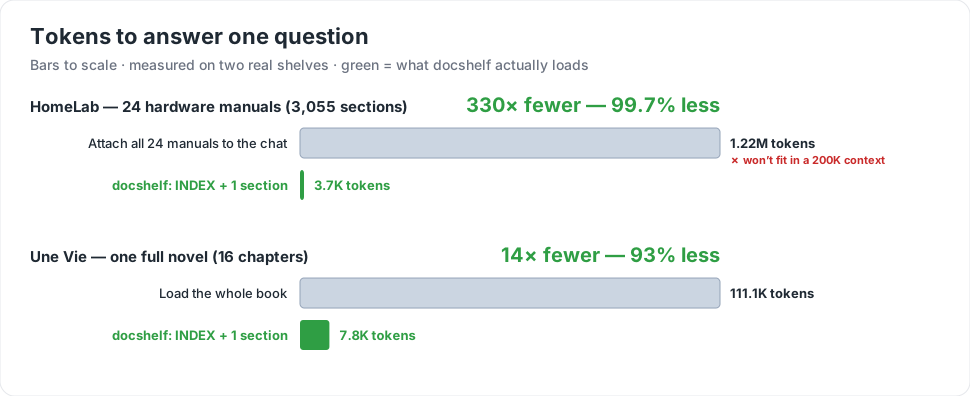
The numbers
To answer a question whose answer lives in one section of one document, an
LLM can (A) dump the whole collection into context, (B) load the whole
containing manual, or (C) do it the docshelf way — read INDEX.md, then fetch
just that section.
| Shelf | Docs / sections | INDEX.md |
Whole collection (A) | Biggest document (B) | docshelf: INDEX + 1 section (C) | Savings |
|---|---|---|---|---|---|---|
| HomeLab | 24 / 3,055 | 3.5K | 1.22M | 1.05M (RouterOS) | 3.7K | 99.7% vs collection |
| Une Vie | 1 / 16 | 0.7K | 111K | 111K | 7.8K | 93% vs the book |
Two things stand out:
- The naive approaches often don’t even fit. Dumping the HomeLab collection (1.22M tokens) overflows a 1M-token context window; the RouterOS manual alone (1.05M) overflows a 200K window five times over. The docshelf query is 3.7K tokens — it fits with room to spare, every time.
- Savings scale with the collection. The more (or bigger) the documents,
the larger the win — because the docshelf cost stays flat:
INDEX+ one section, regardless of how much sits behind the index.
Methodology
- What’s counted. For each shelf:
INDEX.md, every full document, and every split section. The “docshelf query” istokens(INDEX) + tokens(median section)— one index read plus one section fetch. “Whole collection” is the sum of the full documents; “biggest document” is the largest single one. - The result is robust, not cherry-picked. The win comes from the index, not from picking a tiny section: even if the model fetched five sections instead of one, the HomeLab query would be ~4.3K tokens — still 99.6% below dumping the collection. The headline barely moves.
- Token counting. Network-free by default, using OpenAI’s published rule of
thumb of ~4 characters per token. Because all three measures use the same
counter, the tokenizer cancels out of the savings percentages — the
ratios are estimator-independent; only the absolute counts move (±10-20%)
between tokenizers. Pass
--tiktokenfor exact GPT (cl100k_base) counts. - Honest framing. These are reproducible measurements of the two repos above, not telemetry from live chat sessions. They quantify the ingestion cost of the retrieval step — the part docshelf changes — not end-to-end answer quality.
Reproduce it (on these shelves, or your own)
git clone https://github.com/ignatenkofi/docshelf-mcp
python docshelf-mcp/benchmarks/token_savings.py /path/to/your/shelf
# exact GPT tokens instead of the estimate:
python docshelf-mcp/benchmarks/token_savings.py --tiktoken /path/to/your/shelf
Point it at any shelf (a directory with an INDEX.md and a docs/ tree) to
get your own numbers. The script and the chart generator live in
benchmarks/.
Back to the docshelf-mcp landing page · repo.